


CHLOE WYLDE
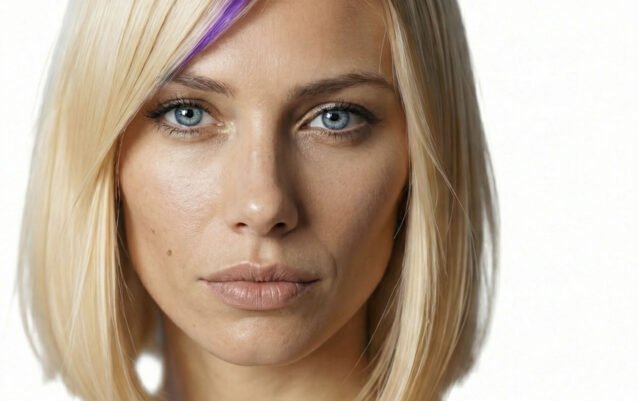
Performance Capture Performer / Action Actress / Digital Body
"On set with my favorite director, Xavier Gens."
THE BODY IS THE INTERFACE
I did not arrive at performance capture by accident. I arrived there because it is the only place where everything I love can exist at the same time: acting, the body, martial arts, technology, animation, monsters, heroines, villains, beautiful bugs, absurd repetition, and that very strange sensation of giving a soul to something that does not exist yet.
Inside a capture volume, you cannot lie for long. The body tells everything: fear, fatigue, intention, control, doubt, ego, precision. You can have a strong silhouette, good light and a great attitude; if the movement has no logic, the machine exposes you immediately. Mocap is brutally honest. That is why I love it.
I work with my body, but I always think about what will happen to it next: tracking, solving, retargeting, the rig, cleanup, readability, character behavior. A take is not only a take. It becomes material that will pass through the hands of technicians, animators, supervisors, directors, digital creatures and sometimes monsters with six arms.
My job is to give them something alive, clear and usable.
I do not want to simply move well. I want the intention to survive the machine.
THE BODY IS THE INTERFACE
I did not arrive at performance capture by accident. I arrived there because it is the only place where everything I love can exist at the same time: acting, the body, martial arts, technology, animation, monsters, heroines, villains, beautiful bugs, absurd repetition, and that very strange sensation of giving a soul to something that does not exist yet.
Inside a capture volume, you cannot lie for long. The body tells everything: fear, fatigue, intention, control, doubt, ego, precision. You can have a strong silhouette, good light and a great attitude; if the movement has no logic, the machine exposes you immediately. Mocap is brutally honest. That is why I love it.
I work with my body, but I always think about what will happen to it next: tracking, solving, retargeting, the rig, cleanup, readability, character behavior. A take is not only a take. It becomes material that will pass through the hands of technicians, animators, supervisors, directors, digital creatures and sometimes monsters with six arms.
My job is to give them something alive, clear and usable.
I do not want to simply move well. I want the intention to survive the machine.
CHLOE WYLDE


FORGED BY THE DOJO
I started martial arts at four. At that age, you do not really understand words like discipline, repetition or mastery. You understand that you have to step onto the tatami in silence, look, bow, listen, fall, get up, and try again.
My father gave me that idea very early: privilege means nothing if you have no spine. He was not trying to raise a decorative princess protected from the world. He wanted me to learn calm, spatial respect and responsibility for my own body. My mother gave me something else: elegance, rhythm, the beauty of lines, image, symmetry and presence. Between the two of them, I grew up with a very simple obsession: to be precise without becoming cold, strong without becoming hard, visible without becoming empty.
Over the years, I trained in judo, Shotokan karate, aikido, taekwondo, boxing, kickboxing, Muay Thai, grappling, Brazilian jiu-jitsu, Kali / Eskrima, fall control, screen combat and prop weapon work. I would never pretend to be a master of all of them. That would be ridiculous. But each discipline gave me a different grammar: axis, distance, timing, impact, deception, recovery, ground contact, partner awareness.
That grammar became my language as a performer.
MARTIAL CINEMA AS A SECRET SCHOOL
I dissected Bruce Lee movies the way other people study musical scores. Freeze frame. Rewind. Slow motion. Acceleration. Economy of movement. I wanted to understand why a movement could feel faster than its real speed, why a stance could tell a threat before the attack even happened.
Bruce Lee taught me explosiveness and the philosophy of motion. Jackie Chan taught me rhythm, invention, comic danger and the use of the environment. Jet Li taught me the purity of trajectories. Donnie Yen taught me impact and pressure. Michelle Yeoh taught me elegance under constraint. Jean-Claude Van Damme taught me line, extension and the almost graphic shape of the body in action. Tony Jaa taught me vertical brutality. Sammo Hung taught me that timing can be stronger than force.
Then digital cinema opened another door. The Lord of the Rings, Avatar, the work of Andy Serkis, creature performance capture and hybrid characters made me understand that an actor could become bigger than appearance. Technology does not replace acting. It exposes it. It amplifies it. It tests it.
That is exactly where I wanted to live.
Rachel Jackson
New YorkRachel Jackson
New YorkRachel Jackson
New YorkPERFORMANCE CAPTURE IS A TEAM SPORT
I am deeply attached to technicians. Truly.
Inside a volume, they are the first to know if you are cheating. They know when your center of gravity is false, when your foot slides, when your strike has no impact, when your face is playing an emotion that your body contradicts. They see everything. And when you respect them, they give you incredible information.
I love that dialogue.
A supervisor can tell me: “The intention is good on this take, but your ground contact is too soft.” An animator can add: “The movement is beautiful, but it will not survive the retargeting.” Instead of taking it personally, I find that brilliant. It is concrete. I can correct it. The character becomes better.
Performance capture is not “I do my show and someone figures it out later.” It is a chain of trust.
I need to understand what the director is looking for emotionally, what the choreographer needs physically, what the mocap supervisor has to recover technically, what the animator will need to save or amplify, and what the character must make the audience feel.
When all of that aligns, something magical happens: the character starts breathing.
UNREAL ENGINE AND THE TRUTH OF REAL TIME
I love Unreal Engine because it makes lies very visible.
When you see your movement replayed almost immediately inside a real-time environment, the speech is over. You see whether it works. You see whether your character has weight. You see whether the camera understands your intention. You see whether the action reads. You see whether you are cool or whether you look like a toaster having an existential crisis.
I do not pretend to be a senior technical artist. There are people whose entire job is that, and I respect them enormously. But I want to understand their language. I want to be able to look at a preview and talk about root motion, timing, silhouette, retargeting, intention lost in the rig, foot sliding or impact readability without looking like a tourist.
For me, that is what being a modern performer means: not only acting in front of the camera, but understanding the complete chain of transformation.
Cinema, video games, virtual production and performance capture are merging. Actors who are not interested in technology are going to miss an entire world.
I want to stand in the middle of the collision.
THE JAPANESE DISCIPLINE
What I love about Japanese rigor is that it does not need to brag.
In some studios, everyone speaks loudly, everything moves fast, everything has to be “amazing.” I like that energy too. But in Japan, I discovered something else: a concentration that is almost silent. A way of working that says: “We are not here to impress the room. We are here to respect the gesture.”
It changed me.
When I enter a volume, I often think of the dojo. Not because I am mystical. Because it is practical. You bow. You listen. You repeat. You fall. You get up. You correct. You try again. You thank the team. And you never forget that talent does not excuse a lack of precision.
It can sound austere. In reality, it is joyful. When you stop trying to look brilliant, you can finally work seriously. And sometimes, by working seriously, you become truly interesting.
ACTION, ANTAGONISTS AND THE JOY OF BEING DANGEROUS
I love playing antagonists.
Not because I want to be “evil.” Because antagonists are often the freest characters. They have a logic, a wound, an obsession, sometimes an elegance. They do not always ask for the audience’s love, but they demand its attention.
On my upcoming project under the direction of Xavier Gens, I discovered how subtle a dangerous character can be. A real threat does not need to shout all the time. Sometimes she enters a room, barely moves, and everyone understands there is a problem.
That kind of role interests me: women who are not only “strong” because they can fight, but because they think fast, observe well, absorb pressure, adapt, and choose the right moment to strike.
Badass is not making a face while holding a weapon. Badass is the calm before impact.
CURRENT AND CONFIDENTIAL
There are projects I cannot talk about.
It is frustrating, because I want to tell everything. But I also deeply respect teams, studios, producers, directors and NDAs. Confidentiality is part of the job. Mystery too.
I can only say this: I am attracted to projects that mix adventure, technology, literature, action and vertigo.
And sometimes one name is enough to open a door.
Jules Verne.
That is all. I said nothing.
Almost.
SHORT BIO
Chloe Wylde is a performance capture performer and action actress operating at the intersection of martial discipline, physical acting and digital culture. Shaped by martial arts from childhood, fascinated by Japanese rigor and mocap workflows, she brings a rare combination to set: body precision, dramatic presence, endurance, humor, technical curiosity and an understanding of the digital pipeline.
She works where the body becomes data, where data becomes character, and where the character still has to remain human.
QUOTES
“I do not want to simply move. I want the intention to survive the machine.”
“Badass is not noise. Badass is the calm before impact.”
“Inside a capture volume, the body is an interface. And the interface has to be honest.”
“I respect people who master their tool. A sword, a camera, a rig, a line of code: same fight.”
“I can go from Bruce Lee to Unreal Engine, then ask for a banana. I find that very balanced.”